
Commercial HVAC Heating Startup Checklist for Austin Businesses
September 21, 2026 — Austin, TX
Austin’s commercial rooftop units have spent the last six months doing one job: cooling. The heat side of those same units — gas burners, heat strips, heat pump defrost controls — has been sitting idle since spring. The first real cold front, usually in late October or November, is the first time most of that equipment has been asked to fire in half a year.
That’s why no-heat calls arrive in waves. When a cold morning hits, thousands of units across Austin, Round Rock, Pflugerville, and Georgetown switch to heat at the same time, and the ones with a weak igniter, a dirty flame sensor, or a failed limit switch all fail the same week. A heating startup check done now moves your building out of that queue.
Gas Heat on Rooftop and Packaged Units
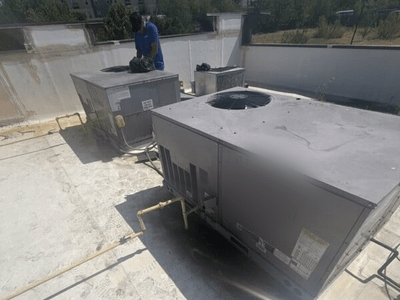
Most restaurants, retail spaces, and offices in the Austin area run packaged rooftop units with gas heat. A proper startup check fires the heat section and measures it, rather than just confirming the unit turns on:
- Heat exchanger inspection — checked for cracks, rust-through, and hot spots. A cracked heat exchanger can let combustion gases, including carbon monoxide, into the supply air, so this is the most important check on the list.
- Burners and flame pattern — cleaned and checked for even, stable flame. Debris, rust scale, and insects build up over a summer of sitting idle.
- Ignition and flame sensor — the hot surface igniter or spark ignition tested, and the flame sensor cleaned. A dirty flame sensor is one of the most common reasons a unit lights, runs for a few seconds, and shuts itself off.
- Inducer motor and pressure switch — verified so the unit proves proper venting before it lights.
- Limit and rollout switches — tested. These safeties shut the burners down when something is wrong, and a tripped rollout switch is a warning sign, not a reset button.
- Gas pressure, connections, and flue — manifold pressure checked, connections leak-tested, and the flue opening cleared of nests and debris.
Electric Heat Strips and Heat Pumps
Not every rooftop unit burns gas. Many Austin buildings — especially smaller suites and newer construction — heat with electric strips or heat pumps, and those have their own failure points:
- Heat strip elements and sequencers — each stage checked for amp draw, so a burned-open element or stuck sequencer is found before you’re short on capacity.
- Contactors and wiring — heat strips pull heavy current, and loose or heat-damaged connections show up as tripped breakers on the first cold day.
- Heat pump reversing valve and defrost controls — the reversing valve confirmed to shift into heating, and the defrost board and sensors checked so the outdoor coil doesn’t ice over on a cold, damp morning.
No heat on a cold morning? Call 512-992-5537 — we run 24/7 emergency commercial HVAC service across Austin and the surrounding area, and we’ll get a technician headed your way fast.
Controls, Economizers, and Airflow
A heating section in perfect shape still can’t heat a building if the controls or airflow are working against it:
- Thermostat changeover and schedules — heat mode, setpoints, and occupied/unoccupied schedules confirmed, so the building warms up before staff and customers arrive.
- Economizer dampers — an economizer stuck open pulls cold outside air straight into the space, and it’s a common cause of “the heat is on but the room is cold” complaints.
- Filters, belts, and blower — a clogged filter or slipping belt cuts airflow across the heat exchanger, which can trip the high limit and shut the burners down.
Warning Signs When the Heat First Comes On
Call for service if you notice any of these after switching over to heat:
- The unit lights, runs briefly, then shuts off and repeats
- The fan runs but the air coming out is cool
- A breaker trips when the heat stages on
- The thermostat or unit control shows a lockout or fault code
- Staff complain of headaches or stuffy air once the heat is running
If anyone smells gas, don’t try to restart the equipment — get people out of the area and call your gas utility first, then call us.
Schedule the Check Before the Rush
The best time for a heating startup check is now, while the weather is still mild and a problem can be fixed on your schedule instead of on the coldest morning of the year. It’s the fall counterpart to our pre-summer commercial AC tune-up checklist, and it fits naturally into a commercial HVAC preventative maintenance plan that covers cooling in spring and heating in fall. If a startup check turns up a failed part, our commercial HVAC repair team can usually handle it in the same visit.
To get your rooftop and packaged units checked before the first cold front, call Setpoint Services at 512-992-5537. Licensed in Texas (TACLA00116720C), serving Austin, Pflugerville, Round Rock, Georgetown, Cedar Park, Leander, Hutto, Taylor, Kyle, Buda, Jarrell, Temple, Belton — and surrounding Austin Area communities.
Check out the Areas We Serve and jobs we are doing by clicking: https://setpoint.services/areas-we-serve/



