
Bohn Heatcraft Walk-In Cooler Refrigeration Diagnostics & R-404A Recharge – Circuit of the Americas, Austin, TX 10.24.26
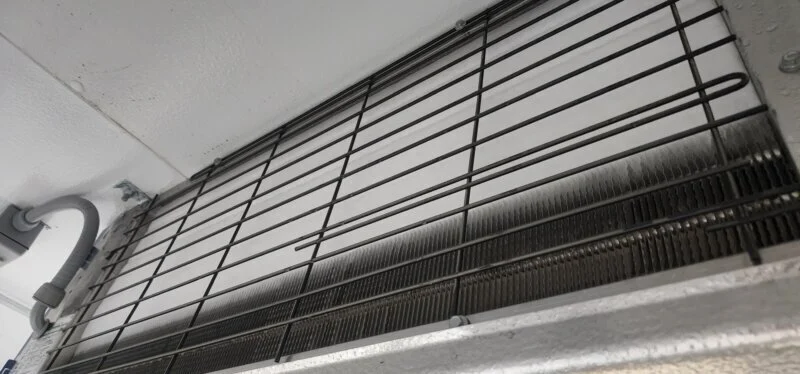
Setpoint Services performed commercial walk-in cooler refrigeration diagnostics and service for Spartan Constructors at Circuit of the Americas (COTA) in Austin, Texas. The refrigeration system consisted of a Bohn/Heatcraft BCH0027MBACYA0000 condensing unit, BEL0095AY6AMAG0210 evaporator, and Copeland YS19KAE-PFV-ARZ compressor.
Upon arrival, the walk-in refrigeration system was shutting down on low pressure and failing to maintain proper cooling temperatures. Technicians introduced nitrogen to assist with refrigerant leak detection, although no leak was identified during the visit. The existing refrigerant was recovered, and the refrigeration circuit was evacuated to approximately 600 microns. Following isolation, the vacuum increased to approximately 1,200–1,500 microns, requiring further investigation to determine whether residual moisture, refrigerant, or a possible leak was contributing to the vacuum rise.
During refrigerant recovery, frost was observed forming on the liquid-line filter drier, raising concerns about a possible refrigerant restriction. However, a restriction could not be confirmed during the initial inspection.
The system was subsequently recharged with approximately 7 pounds of R-404A refrigerant until the sight glass appeared clear. The Heatcraft evaporator controller was also configured for R-404A operation. Refrigeration performance was monitored, with approximately −2°F suction saturation temperature and 70°F condensing saturation temperature recorded at an outdoor ambient temperature of approximately 60°F.
During testing, the walk-in cooler temperature decreased from approximately 56°F to 44°F, confirming that the system was producing cooling. However, the equipment had not yet reached its programmed setpoint, and normal cycling could not be verified before departure.
Additional refrigeration diagnostics were recommended to verify the proper refrigerant charge, electronic expansion valve feeding, head-pressure control operation, and the underlying cause of the original low-pressure shutdown. The system was cooling at the conclusion of the visit, but the refrigeration issue remained under investigation.


