
Commercial Rooftop Unit Not Heating: Common Causes for Austin Businesses
October 19, 2026 — Austin, TX
The first cold front of the season is when rooftop units that sat idle on the heat side all summer are asked to work again — and when the no-heat calls start. For a restaurant, retail floor, or office, a building that will not warm up in the morning means staff in jackets, customers who leave early, and, in a hard freeze, risk to plumbing and product.
Most commercial buildings around Austin heat with packaged rooftop units: gas-electric “gas-packs” or heat pump units with electric heat strips. When one stops heating, the cause is usually one of a short list of components. Here is what our technicians check first, and what an operator can safely look at before calling.
How a Gas Rooftop Unit Makes Heat
Knowing the sequence explains most failures. On a call for heat, a gas-pack runs through a fixed order:
- The thermostat or building controls send a heat call to the unit’s control board.
- The inducer (draft) motor starts, pulling air through the heat exchanger and out the flue.
- A pressure switch proves the inducer is moving air.
- The ignitor heats up or sparks, and the gas valve opens.
- The flame sensor proves the burners are lit.
- After a short delay, the supply fan starts and pushes warm air into the building.
If any step fails to prove, the control board stops the sequence — often retrying a few times before it locks out. Where the sequence stops points to the part that failed.
Common Causes of a Commercial Rooftop Unit Not Heating
- Dirty or failed flame sensor. The burners light, then shut off within seconds because the board cannot confirm flame. One of the most common first-cold-day calls.
- Cracked or worn ignitor. Hot surface ignitors are brittle and wear out over time. No glow or spark means the gas valve never opens.
- Inducer motor or pressure switch faults. A seized inducer, a cracked pressure hose, or a blocked flue — including nests and debris collected over the summer — keeps the unit from proving draft.
- Tripped high limit or rollout switch. These safeties open when heat or flame goes where it should not. A tripping high limit usually means low airflow: clogged filters, a slipped or broken belt, or a failing supply fan. A tripped rollout switch is a warning about flue or heat exchanger condition and should never just be reset and ignored.
- Gas valve or gas supply. A failed gas valve, or something as simple as a gas cock left closed after other work on the roof.
- Thermostat, controls, or economizer. A wrong schedule, a heat call lost between the building automation system and the unit, or an economizer damper stuck open that pulls in cold outside air faster than the unit can heat it.
- Heat pump rooftop units. Defrost problems, a failed reversing valve, or electric heat strips and sequencers that never come on.
When the Heat Exchanger Is the Problem
The heat exchanger separates burner combustion gases from the air your staff and customers breathe. Over years of heating cycles the metal can crack or corrode through, especially on older units and units that have run with poor airflow. A cracked heat exchanger can let combustion gases, including carbon monoxide, into the airstream, so a unit with a confirmed crack should stay off until it is repaired or replaced.
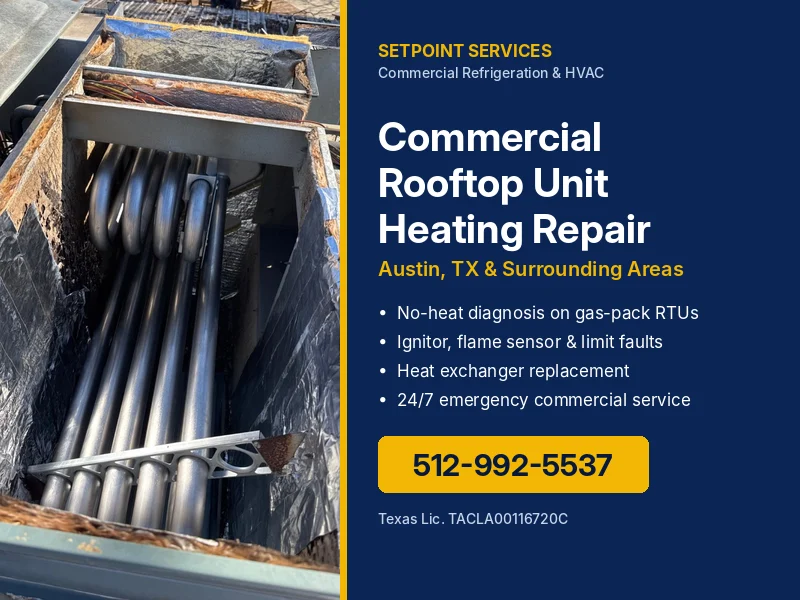
This past January our team replaced the heat exchanger on a rooftop unit serving a South Austin business. The photo with this post is from that job: the new tubular heat exchanger set in the unit’s heat section before the panels went back on. Depending on the unit’s age and overall condition, a heat exchanger replacement can be the right repair, or the cost can tip the decision toward replacing the rooftop unit. We lay out both options so the owner can decide.
Rooftop unit blowing cold air on a cold morning? Call 512-992-5537. Setpoint runs 24/7 emergency commercial HVAC service across Austin, and no-heat calls during a cold snap get a technician on the roof fast.
What Operators Can Check Before Calling
- Confirm the thermostat is set to heat, the setpoint is above room temperature, and the schedule is not in an unoccupied setback.
- Check that the breaker for the unit is on.
- Replace filters if they are overdue — a clogged filter alone can trip a high limit.
- If your maintenance staff has safe roof access, note any blinking light or fault code on the unit’s control board and pass it along when you call.
Leave the gas, burner, and electrical compartments to a licensed technician, and do not repeatedly reset a tripped safety switch. Each trip is the unit reporting a problem.
Prevention: Start the Heating Season Right
Many of these failures appear in the first week of heating because the heat side has not run since spring. A pre-season startup catches dirty flame sensors, weak ignitors, blocked flues, and worn belts before the first cold front. Our commercial HVAC heating startup checklist walks through what that visit covers, and a commercial HVAC maintenance plan keeps it on the calendar every fall.
Commercial Heating Repair Across the Austin Area
Setpoint Services diagnoses and repairs gas-pack and heat pump rooftop units for restaurants, retail stores, offices, and other commercial buildings. See our commercial HVAC repair services, or commercial HVAC installs when replacement is the better call.
For the fastest response, call 512-992-5537. We serve Austin, Pflugerville, Round Rock, Georgetown, Cedar Park, Leander, Hutto, Taylor, Kyle, Buda, Jarrell, Temple, Belton, and surrounding Austin Area communities.
Setpoint Services — Commercial Refrigeration & HVAC Repair serving Austin, TX and surrounding areas.
Check out the Areas We Serve and jobs we are doing by clicking: https://setpoint.services/areas-we-serve/


