
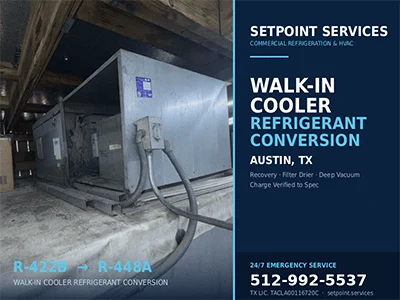
Walk-In Cooler Refrigerant Conversion in Austin, TX: R-422B to R-448A
Near Guadalupe St, Austin, TX 78705
July 13, 2026 — Austin, TX
Not every refrigeration service call is a breakdown. Sometimes the smartest thing an operator can do is get ahead of one — and for an Austin restaurant running an older walk-in cooler, that meant converting the system off an aging refrigerant blend before parts, refrigerant supply, or a hot July afternoon forced the issue.
Setpoint Services completed a full refrigerant conversion on the cooler, taking it from R-422B to R-448A. The equipment is the same. The refrigerant circulating through it is not — and that change buys the operator years of easier, cheaper service down the road.
Why Convert a Working Walk-In Cooler
R-422B is a service blend that showed up widely as a drop-in replacement when R-22 was being phased out. It kept a lot of equipment running through that transition, and it still works. The problem is what comes next: as federal HFC phasedown rules tighten, higher-GWP service blends get harder to source and more expensive to buy, while the technicians and suppliers around you standardize on newer refrigerants.
R-448A is one of those newer standards. It is a lower-GWP blend widely stocked for commercial refrigeration, well supported across the supply chain, and a good performance match for medium-temperature walk-in cooler applications. Converting on your own schedule — while the box is holding temperature and the kitchen is running — costs a planned service visit. Converting after a failure, when refrigerant is scarce and product is warming, costs considerably more.
The Conversion, Step by Step
A refrigerant changeover is not a top-off. Done properly, it is a full sealed-system procedure:
- Recovery — the existing R-422B charge was recovered into approved cylinders, in line with EPA refrigerant handling requirements. No venting, no shortcuts.
- Liquid line filter drier replacement — the drier holds the moisture and contaminants it has collected over the system’s life. Leaving the old one in place on a conversion defeats the purpose of the whole job.
- Deep vacuum — the system was evacuated to a deep vacuum to pull out residual moisture and non-condensable gases before any new refrigerant entered the circuit.
- Virgin R-448A charge — the system was charged with virgin refrigerant rather than reclaimed stock, so the operator starts the next chapter of this cooler’s life on a known-clean charge.
That drier and vacuum step is where conversions are won or lost. Moisture left in a sealed system reacts with refrigerant and oil, forms acid, and eats compressors from the inside. It is invisible on day one and expensive in year two.
Walk-in cooler running warm, or still on an older refrigerant blend? Call 512-992-5537. Setpoint Services runs 24/7 emergency service across Austin and the surrounding area — and we will tell you honestly whether your system is a conversion candidate or a replacement candidate.
Dialing In the Charge After Startup
R-448A is a zeotropic blend, which means it does not behave identically to what came out of the system. Charge weight from the old refrigerant does not simply carry over, and the system has to be tuned to the new fluid rather than assumed correct.
After startup, our technician adjusted the charge while watching the numbers that actually describe system health:
- Operating pressures on both the high and low side, confirming the system was landing where it should for a medium-temperature box
- Superheat at the evaporator, verifying the coil was being fed correctly and no liquid was heading back toward the compressor
- Subcooling at the condenser, confirming a solid column of liquid refrigerant reaching the metering device
Those three readings together are what separate a converted system that runs well from one that merely runs. A cooler can hold temperature on a sloppy charge for a while — right up until the compressor pays for it.
Labeling the System Is Part of the Job
Before leaving, the technician installed a new refrigerant identification label on the equipment. This is not a formality. The next tech who opens this system — whether that is us next year or somebody else at 11 p.m. on a Saturday — needs to know at a glance that they are working on R-448A and not the R-422B the original nameplate implies.
Unlabeled converted systems are one of the more common ways good refrigeration equipment gets damaged: a well-meaning tech tops off with the wrong refrigerant, and now the box is running on a blend nobody can diagnose. Final testing confirmed stable operation and proper box temperature, and the cooler was returned to service.
Planning Your Own Conversion
If you operate a restaurant, grocery, convenience store, or shared kitchen in the Austin area and your refrigeration is still running an older service blend, the question is not whether you convert — it is whether you pick the date or the equipment picks it for you. A preventative maintenance agreement is the natural place to plan that work, alongside routine service on your reach-in coolers, ice machines, and HVAC systems.
Setpoint Services is a licensed Texas commercial refrigeration and HVAC contractor (TACLA00116720C) based in Pflugerville. To schedule a refrigerant conversion, a system assessment, or emergency service, call 512-992-5537. We serve Austin, Pflugerville, Round Rock, Georgetown, Cedar Park, Leander, Hutto, Taylor, Kyle, Buda, Jarrell, Temple, Belton — and surrounding Austin Area communities.
Setpoint Services — commercial refrigeration and HVAC for the Austin Area.
Check out the Areas We Serve and jobs we are doing by clicking: https://setpoint.services/areas-we-serve/



